

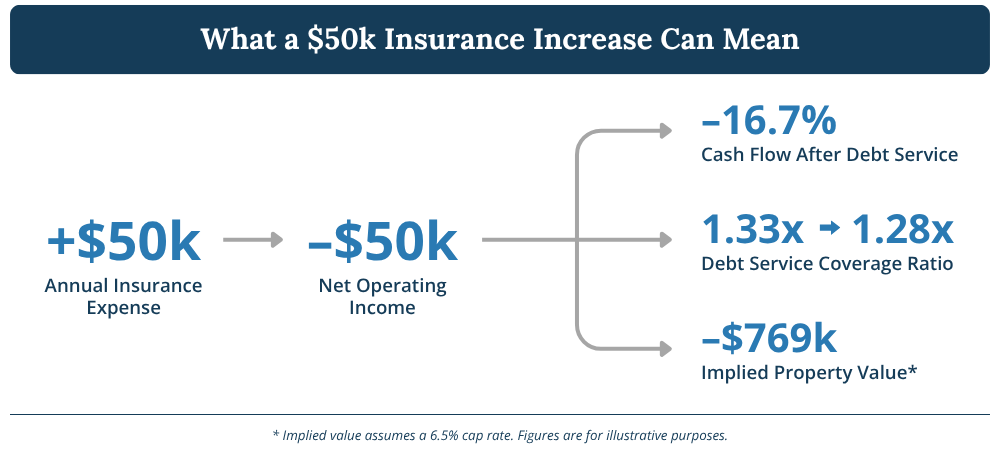
A $50,000 insurance increase at insurance renewal doesn’t stop at the premium. It reduces net operating income (NOI) by $50,000 and, at a 6.5% cap rate, can translate to roughly a $769,000 reduction in implied property value.
Consider a hypothetical multifamily property with an annual insurance premium of $200,000. At renewal, that premium increases 25% to $250,000. The additional $50,000 is the obvious cost, but here’s what it can mean for the rest of the property’s financials.
The math behind that $769,000 figure starts with NOI. Insurance is an operating expense, so assuming revenue and other expenses remain unchanged, an additional $50,000 in annual insurance expense reduces NOI by the same $50,000.
Income-producing commercial real estate is commonly valued based on the income it generates. Using a 6.5% capitalization rate:
$50,000 ÷ 6.5% = approximately $769,000
If the market capitalizes the property's $50,000 reduction in NOI at 6.5%, the implied property value is approximately $769,000 lower.
That doesn’t mean the owner has immediately lost $769,000. Property values depend on many factors, including the cap rate applied to the property. At a 5.5% cap rate, the same $50,000 reduction in NOI equates to approximately $909,000 in implied value. At a 7% cap rate, it equates to approximately $714,000. Even across that range, the potential effect on value is many times larger than the annual premium increase itself.
For a property with debt, a higher insurance bill can have an outsized effect on the cash flow available to the owner because debt service generally doesn’t decline when operating expenses increase. The same increase can also weaken debt-service coverage, even though the property’s debt payment hasn’t changed.
Suppose the property generates $1.2 million in annual NOI before the renewal and has $900,000 in annual debt service. That leaves $300,000 in cash flow after debt service. After the $50,000 insurance increase, NOI falls to $1.15 million. Debt service remains $900,000, leaving $250,000.
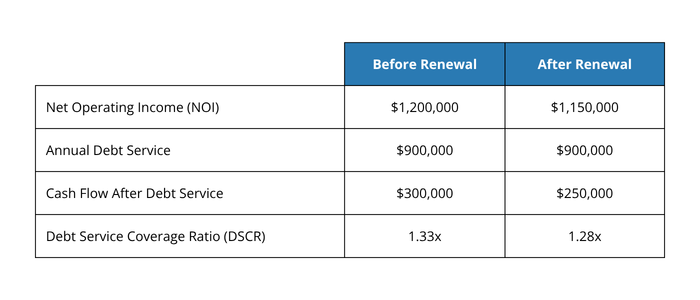
The property's insurance expense increased by $50,000, but the cash flow remaining after debt service fell by 16.7%. At the same time, debt service coverage ratio (DSCR) declined from 1.33x to 1.28x.
For properties with less room between NOI and debt service, the impact is even more evident. The debt payment is fixed, so the additional insurance expense comes out of the cash that would otherwise remain with the owner. It also reduces the property's cushion above its debt obligations, which is a change that can matter when lenders evaluate debt-service coverage.
The deductible determines how much of a covered loss the owner may have to absorb before insurance responds. With percentage deductibles, the dollar amount can be much larger than the percentage initially suggests.
A 5% deductible does not necessarily mean the owner pays 5% of the loss. Depending on the policy, the percentage may be applied to the insured value of a building, location, or other defined value. That can leave the owner responsible for hundreds of thousands or even millions of dollars after a covered loss.
For example, if a policy applies a 5% deductible to $20 million of applicable insured value, the deductible would be $1 million. The actual calculation depends on the policy language and the values to which the percentage applies.
This is why a lower premium at insurance renewal doesn’t always mean a lower-cost insurance program. If the premium savings come with a materially higher deductible, more of the financial risk has shifted back to the property owner. Before comparing renewal options, the deductible needs to be translated into the actual dollars the owner could be responsible for funding.
Insurance can affect debt in two separate ways:
An insurance renewal option that reduces the property's premium may not be viable if the deductible or coverage terms fall outside those requirements. Insurance may sit in operating expenses, but its impact can reach directly into debt economics, asset value, and equity returns.
The premium is an important number, but it doesn't show the full financial effect of a renewal. Owners should also look at:
Before you call a renewal “good,” translate it into NOI, DSCR, asset value, and retained loss exposure. That is the real cost of insurance.
PEAK Risk Advisors evaluates insurance renewals the way owners, lenders, and investment committees evaluate the property: through NOI, cash flow, DSCR, asset value, and retained risk. Contact us to speak with an advisor and review your renewal.